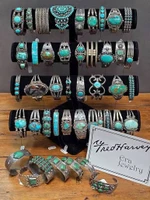
Turquoise among the Hopi Part Three
Tuesday, June 11, 2013 10:07:52 AM America/Phoenix
Hopi Kachina Dolls Part Two
Monday, May 13, 2013 1:05:11 PM America/Phoenix
Turquoise among the Hopi Part Two
Monday, May 13, 2013 12:49:29 PM America/Phoenix
What is a Kachina? Part One of Six
Thursday, May 9, 2013 11:17:31 AM America/Phoenix

Turquoise among the Hopi Part One
Wednesday, May 8, 2013 10:28:05 AM America/Phoenix
Turquoise in the Early 1900's Part Three
Tuesday, April 2, 2013 12:17:00 PM America/Phoenix
Rough Turquoise in 2013
Tuesday, March 26, 2013 9:35:38 AM America/Phoenix
Turquoise in the Early 1900's Part Two
Tuesday, March 26, 2013 9:13:44 AM America/Phoenix
Turquoise finds application by virtue of its supposed efficacy and consequently is prominent in many charms, amulets and fetishes. Few religious rights take place without its use and the paraphernalia of the priesthood abound in objects adorned with it. Turquoise indeed, may be said to hold a fundamental place in the religious ideas of the Pueblo Indians and in their outward ceremonial expression of them. The turquoise utilized varies from very inferior material to really beautiful stones. The majority, however, are of little value as gem material, according to our standards. Turquoise matrix is used along with pure material, although the latter is preferred. The Indian is usually rather keen judge of quality, although he does not so strongly favor the blue color, to the exclusion of the green, as does the white man.
Turquois Use in the Early 1900's
Thursday, March 14, 2013 1:34:35 PM America/Phoenix
This is an expert taken from the book "Turquois" written in 1915, by Joseph Pogue, Memoirs of the National Academy of Sciences. Note the spelling of Turquoise is turquois in 1915. This is Part 1 in a 10 Part series so check back next week.
The turquois is today in wide use among Indians of the Southwest, and it forms one of their most cherished possessions. As in the past, it still finds a ceremonial as well as an ornamental application.
The Pueblo Indians find great pleasure in turquois and seldom is a well-to-do representative seen without ornaments of this material. Especially upon gala occasions and during ceremonies is this stone in evidence, and both sexes bedizen themselves with quantities of it. The turquois is most commonly fashioned into discodial and cylindrical beads and into various-size pendants of oblong, triangular, and keystone outline. The work is performed by rubbing the material on sandstone and polishing on finer material, and the turquoise objects are perforated with a bow-drill, usually tipped with a fragment of quartz or flint. The workmanship is rather crude and the finished piece is seldom symmetrical or highly polished. The beads are usually strung on cord, but sometimes on wire, and one or more strands of turquois are used for turquois necklaces, turquois bracelets, and more rarely turquois ear ornaments (earrings). Discoidal beads are most common; in some strands of turquois these alternate with cylindrical shapes, and pendants may be in inserted, especially towards the center, to give variety. Beads of coral and white shell are often combined with the turquois, although their introduction lessens the value of the string. Turquois pendants are frequently worn alone, suspended from the ears; indeed this is perhaps the most common ornament seen in the Southwest.
Silversmithing and Silver
Wednesday, June 20, 2012 1:58:25 PM America/Phoenix
In addition to tools required for silversmithing, the silver itself is necessary. The old-time Native American silversmith liked coin silver. The old pesos that the Native Indian silversmiths melted for their jewelry probably were of a good grade of silver. The pesos issued for some years previous and until about 1940 were 0.720 fine and could be used for jewelry. These pesos were 1 5/16", in diameter. Then in about 1947 two new coins were struck. a one-peso piece and a five peso piece. The one peso is 0.500 fine and 1 1/4" in diameter. The five peso is of a good quality of silver, marked 0.900. However, coin silver in sheet from can be obtained from some firms, but sterling silver is stocked wherever jewelers' supplies are sold. Pure silver is too soft for ordinary jewelry work except for bezels. Sterling silver is an alloy of 925 parts pure silver and 75 parts copper, and is known as 925-1000 fine. Sterling silver comes in sheet and wire form. Sterling can be had in thickness of 14, 16, 18, 20, 22, 24, and 26 Brown & Sharp gauge, the smallest number being the thickest metal.
For ordinary work, it is well to buy some 16, 18, and 20 gauge silver perhaps 6 inches wide by whatever length is required. The 6 inch width is suggested because that is the usual length for a bracelet, and that is about the longest piece of silver that will be used for making in Indian jewelry. Twenty-gauge silver is just about 1/32 inches thick, while 16 gauge is about 3/64 inch thick. A piece of 26 gauge silver should be bought for making bezels. Bezels are the little rims soldered to jewelry to hold turquoise or other stones. B & S 26 gauge silver is about 1/64 inches thick. Silver usually is sold by weight, but in ordering, it is customary to state the gauge and the dimensions desired.
Silver wire should also be on hand. This comes in thicknesses ranging from 14 to 30 B. & S. gauge. If a draw plate is among the equipment, the buying of wire is generally simplified as one gauge of wire is all that is necessary because the smaller sizes can be drawn as needed.
It is always easier to work with annealed silver. Silver wire usually comes annealed, but it is sometimes necessary to anneal sheet silver. Hammering silver rends to harden it, and drawing wire through a draw plate also hardens it. For this reason, wire is usually pulled through two holes and then coiled, heated, and immersed in cold water or a pickle solution before drawing it thinner or shaping it.
"Squash Blossom" a Brief History
Monday, May 7, 2012 12:12:39 PM America/Phoenix
The unique squash blossom necklace originated by the Navajo from three foreign elements. The silver beads were evidently evolved from two button halves soldered together to make a bead. The buttons were from Spanish clothing decoration. The "squash blossom" was evidently copied from the silver pomegranate blossom seen on the trousers of men from Granada, Spain. The Naja or Crescent shaped pendant was borrowed from the Spanish horse headstall or bridle which in turn was adopted from the Moors who probably got it by way of the Middle east, possibly Mongolia. It was known in many early civilizations; the earliest are solid gold najas found in stone age graves in Ireland. Whatever the origins, the Navajo had the great ability to combine these elements into a beautiful piece of jewelry and the other Indians of the Southwest improved upon it. The Navajo called the squash blossoms themselves "Beads Which Spreads Out"
Alltribes Donates to Troops in Afganistan
Tuesday, March 6, 2012 10:44:33 AM America/Phoenix
Alltribes was both proud and fortunate to have the opportunity to donate hand made product to support a Super Bowl party held in Afghanistan. Along with several other American companies, we helped TASMG TF ( Theater Aviation Sustainment Maintenance Group Task Force ) have a wonderful Super Bowl celebration and were happy to have the honor to support our troops. Our thoughts and prayers are with everyone serving our country, as we continue to pray for our soldiers safe return.
Turquoise in Indian Jewelry
Wednesday, February 29, 2012 8:46:17 AM America/Phoenix
In the early years Indian jewelry was made with very little or no turquoise. It was not until the mid 1940's that turquoise was a mainstay in Indian jewelry. Not to say that turquoise was not used before this time frame; it was mainly just silver work. Today, to the Indian silversmith, using turquoise in jewelry is almost as necessary as the silver itself. In a lot of Zuni jewelry silver is really just something that holds the turquoise. Most poor turquoise is light light blue and sometimes even white and extremely soft and chalky. Most silversmiths use rich blue stones that are hard and durable. Turquoise can be treated in different ways depending on the methods used by the lapidary or silversmith. Not to be misunderstood, it is almost essential to maintain the deep colors and to maintain the stability of the stone. Even when stones are treated, most of the time the stone is still 99% turquoise. If stones go untreated, over time they will change color and more often than not fall apart at some point.
Turquoise can come from all over the American Southwest, Middle East, Africa and China. Most turquoise used in the Southwest comes from New Mexico, Nevada, Arizona and Colorado. Over the years several mines have opened and closed and most of what is being sold on the open market is coming from Nevada and Arizona. Nevada turquoise usually has a wide variety of greenish blues and most from Arizona is known for it's blueish greens. Because of time and costs, a lot of hobbyist are purchasing stones already cut into cabs to save them the trouble of cutting stones. Fortunately at Alltribes we have a lapidary shop and have the pleasure of working with some of the best stone cutters in the business. This is a craft that most silversmiths used to do themselves but lapidary work and silversmithing have separated themselves as different talents over the years. Cutting and polishing stones has become a craft in itself and it takes many years and a lot of patience to create and learn the everlasting gemstone we love called turquoise. Watching a great stone cutter is simply fascinating if you have never seen it done. Especially when it is being cut for inlay turquoise jewelry.
Facebook Meets Alltribes
Wednesday, December 28, 2011 10:03:06 AM America/Phoenix
Near the end of 2011, social networking websites are now reaching over 80% of the world’s online population. A new report states that social networking accounts for one out of every five minutes of users online. Facebook accounts for three out of four minutes of online social network usage. It is essentially dominating the social networking world. Although Alltribes Indian Art was at status quo for the past two years, having a corporate presence has proven to be a major part of the retail sector of a websites success. While lying dormant for two years; Alltribes Indian Art was averaging about 7 new company likes a week. Now with the help of Wholesale Internet Solutions and being active on Facebook as a company, we are averaging about 39 new likes a week. We are extremely pleased to announce that we have reached the 1000 likes mark, and are climbing fast. Brand marketing is really the just of how Facebook can help small business become a household name. This practice is not new. Large corporations have been brand marketing and in your face for years for a good reason. With this new age of advertising Facebook has now surpassed Google as our number one referral source.
Handmade Native American Jewelry
Tuesday, November 29, 2011 3:46:51 PM America/Phoenix
Here at Alltribes Native American Art and Jewelry we continue to hand craft some of the finest Native American Jewelry on the market. Currently we are pumping out handmade turquoise jewelry, concho belts and bracelets for the holiday season. With great artist like Verna Blackgoat, Tom Ahasteen and Joey McCray we are getting it done.
Dream Catchers
Wednesday, November 16, 2011 2:43:05 PM America/Phoenix
Dream catchers are originally a native artifact from the Ojibwa nation. Native mothers would use various threads, such as sinew and yarn and would die it red. They would wrap the threads on wooden hoops and place them or weave them into baby cradle boards. This spider web form would capture anything that may try to pass through. Weather it be harm or sickness or bad feelings and thoughts this would protect them. The dream catcher would also filter out all the bad dreams.
Charles Russell Paintings
Tuesday, November 8, 2011 11:47:01 AM America/Phoenix
Charles Russell lived from 1864 to 1926 and was one of the few great western painters of his time to capture all aspects of the American cowboy and Native American Culture. One of his most famous paintings jerked down in 1907 dramatizes the dangerous work of the American cowboys way of life. In this painting the portrays a steer being roped while another steer trips on the rope pulling both the horse and the cowboy to the ground. Holding a firm grip, the cowboy fights to keep the horses' balance. The cowhand swings his rope in hope to lasso the situation. This method is known as the "hard and fast" method by which a rope is tied to the saddle horn.
Cigar Store Indians
Monday, November 7, 2011 10:05:39 AM America/Phoenix
On This Day Battle of Wabash
Friday, November 4, 2011 9:52:31 AM America/Phoenix
Navajo Veteran A True Story
Tuesday, November 1, 2011 1:54:30 PM America/Phoenix
Usually when we think about Native American veterans, we may think of the Navajo Code Talkers, or the Cherokee Code Talkers of the Great War, or Ira Hayes of Arizona that helped raise the American Flag in Iwo Jima. I would like to introduce you to Joe Kieyoomia an Army soldier that was captured by the Japanese in the Philippines in 1942. Ironically enough Joe was in artillery, as was I in the Marine Corps. Nonetheless, Here is a Navajo veteran whom the Japanese tortured miserably because he was Navajo, and they wanted him to break the Navajo Code talkers code. This Army soldier resoundingly explained to the Japanese that in fact it was all gibberish to him because they used the Navajo language but the code made no sense. There were only a few Navajo's that were designated to decipher the code. Outlasting the torture, not only did Joe survive the Bataan Death march where thousands of our veterans perished, Joe survived the Nagasaki atomic bomb while being held up in a cement cell. Over three years of torture Joe was finally released and lived out his days until 1997. In an interview stated, "Even if I knew about their code, I wouldn't tell the Japanese." What a veteran! While in college, I had the opportunity to go to lunch with two of the original Navajo Code talkers, what an experience. I hope that with Veterans Day in the near future, we thank, admire and continue to support all of our great soldiers that continue to fight for our freedom both past and present.